Custom IoT Hardware Carriers
The core physical foundation of this IoT ecosystem is a pair of custom open-hardware PCB carrier boards designed in KiCad. These boards break out microcontrollers, precision environmental sensors, and low-power e-paper displays into compact modules that mount directly onto standard LEGO plates and enclosures.
Carrier Board Family
-
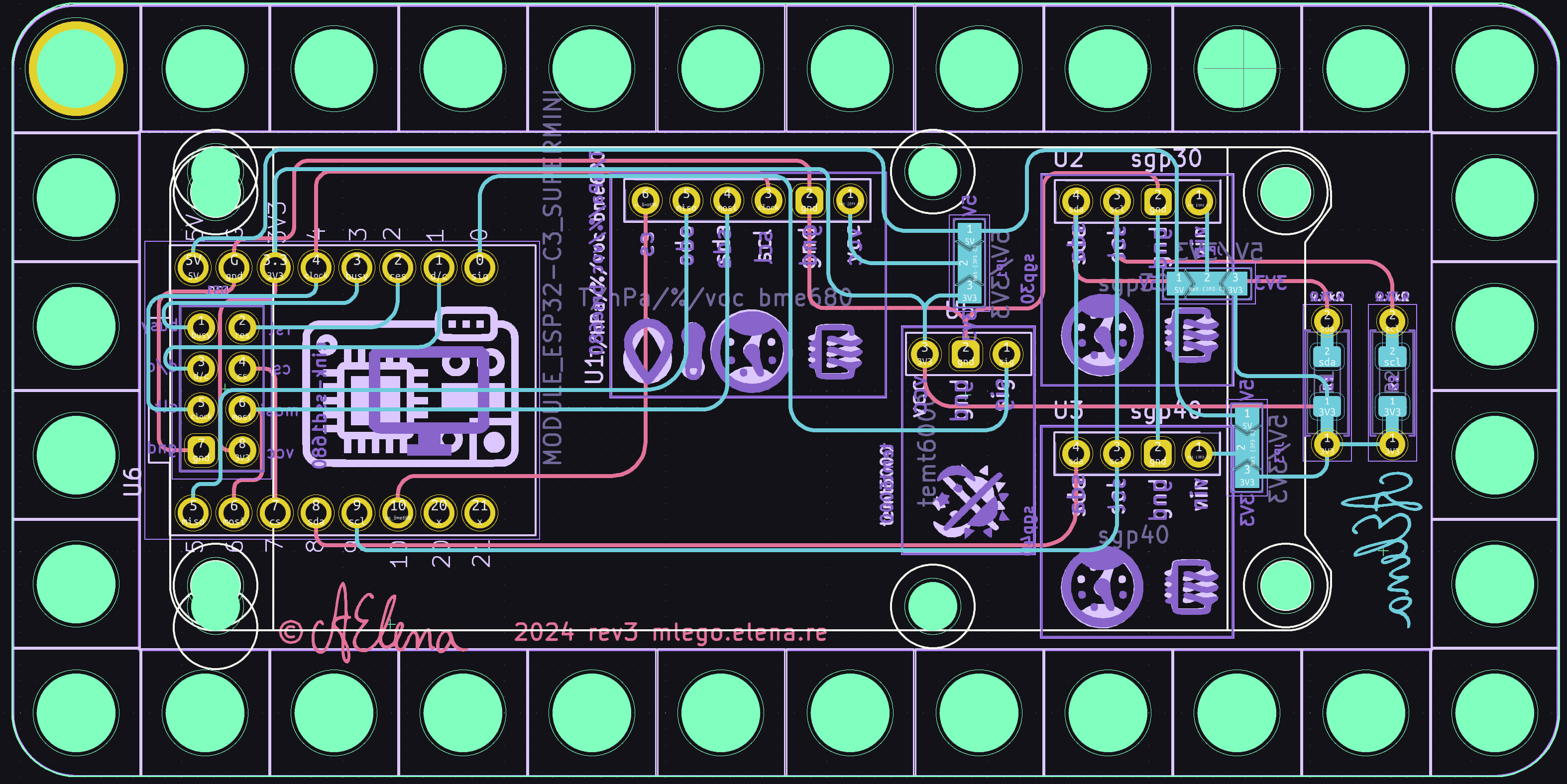
Sensor Carrier 12×6 (Rev 1, 2, 3)
- Footprint: 12×6 LEGO plate (
96 mm × 48 mm) - Microcontroller: ESP32-C3 SuperMini (Rev 3) / ESP32-C3-FH4 WeAct (Rev 1 & 2)
- Display Options: WeAct 2.13" E-Paper (
122 × 250) or 1.54" E-Paper (200 × 200) - Sensors: BME280 / BME680, SGP30 / SGP40, TEMT6000 light sensor
- Socketing: Through-hole sockets for modular replacement of MCU and sensors
- Footprint: 12×6 LEGO plate (
-
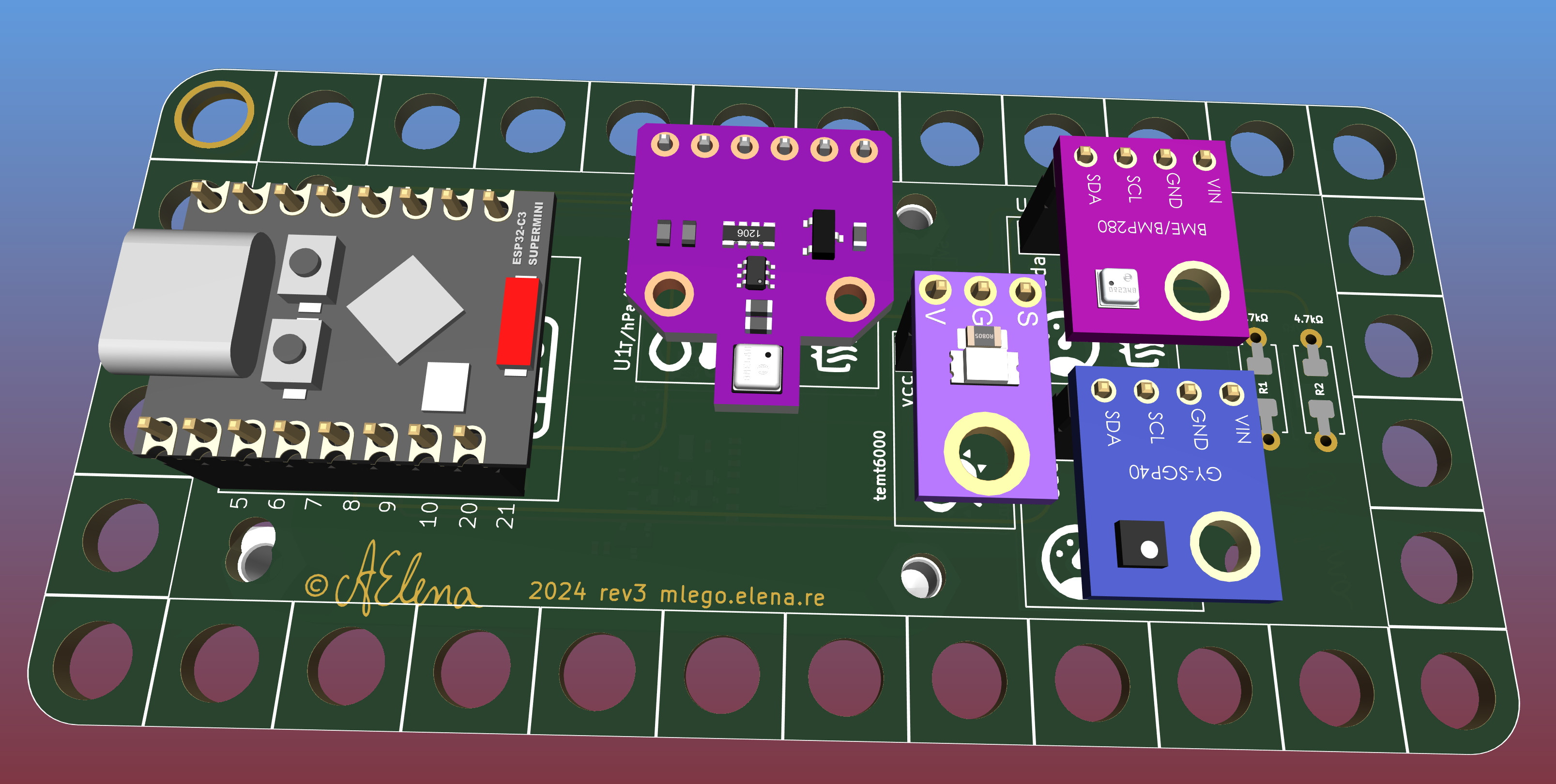
- Footprint: 8×6 LEGO plate (
64 mm × 48 mm) - Microcontroller: ESP32-C6 SuperMini (WiFi 6, BLE 5, Zigbee/Thread capability)
- Display: Dedicated WeAct 1.54" E-Paper (
200 × 200, SSD1680/SSD1681) - Sensors: BME680 via SPI bus (T/P/H/VOC), TEMT6000 ambient light sensor
- Optimization: Ultra-compact surface-mount jumpers with direct LCSC manufacturing BOM
- Footprint: 8×6 LEGO plate (
Hardware Comparison Matrix
| Feature | 12×6 Sensor Carrier (Rev 3) | 8×6 Mini Sensor Carrier |
|---|---|---|
| Target Repository | m-lego/sensor |
m-lego/sensor-1.54 |
| Grid Dimensions | 12 studs × 6 studs (96 × 48 mm) |
8 studs × 6 studs (64 × 48 mm) |
| Mounting Holes | 4 corner holes + 2 center (4.8 mm dia) | 4 corner holes (4.8 mm dia) |
| Microcontroller | ESP32-C3 SuperMini | ESP32-C6 SuperMini |
| Wireless Protocols | 2.4 GHz Wi-Fi 4 (802.11b/g/n), BLE 5 | Wi-Fi 6 (802.11ax), BLE 5.3, Zigbee, Thread |
| Supported Displays | 2.13" B&W/BWR or 1.54" B&W WeAct | 1.54" B&W/BWR WeAct E-Paper |
| Climate Sensor | BME280 (I2C) or BME680 (SPI) | BME680 (SPI bus) |
| Air Quality (VOC) | SGP30 or SGP40 (I2C) | BME680 integrated gas resistance |
| Light Sensor | TEMT6000 (Analog ADC) | TEMT6000 (Analog ADC) |
| Bussing | Dedicated SPI bus + I2C bus | Unified high-speed SPI bus |
| Power Supply | 5V USB-C or 3.3V header rail | 5V USB-C or 3.3V header rail |
Supported Sensor Suite
graph LR
    subgraph MCU ["ESP32 Controller"]
        SPI["SPI Bus<br>(CLK, MOSI, MISO)"]
        I2C["I2C Bus<br>(SDA, SCL)"]
        ADC["ADC Input<br>(Analog GPIO)"]
    end

    subgraph Peripherals ["Sensors & Displays"]
        EPD["WeAct E-Paper Display<br>(CS, DC, RST, BUSY)"]
        BME680["Bosch BME680<br>(Temp, Humidity, Pressure, Gas)"]
        BME280["Bosch BME280<br>(Temp, Humidity, Barometer)"]
        SGP["Sensirion SGP40<br>(VOC Index Algorithm)"]
        TEMT["TEMT6000 Sensor<br>(Illuminance / Lux)"]
    end

    SPI --> EPD
    SPI --> BME680
    I2C --> BME280
    I2C --> SGP
    ADC --> TEMT
1. Environmental Sensing
- Bosch BME280: Combined digital temperature, relative humidity, and barometric pressure sensor communicating over I2C (
0x76or0x77). Extremely stable baselines and low current draw. - Bosch BME680: Upgraded 4-in-1 sensor with volatile organic compound (VOC) gas sensing and metal oxide resistance measurements, connected over high-speed hardware SPI.
- Sensirion SGP30 / SGP40: Dedicated metal-oxide gas sensor calculating indoor VOC index (1–500 scale) with on-chip humidity compensation fed directly from the BME280 state.
2. Ambient Light & Power Gating
- TEMT6000: High-sensitivity phototransistor tuned to human eye sensitivity (~570 nm peak). Output voltage directly correlates with room illuminance.
- Used across the ESPHome fleet to conditionally inhibit E-Paper display refreshes whenever the ambient light level drops below
1.0 lx(e.g. night in bedrooms), avoiding unwanted ghosting clears or clicking relays.
Why Modular LEGO Enclosures?
- Precision & Consistency — Injection-molded LEGO bricks provide tolerances under 0.01 mm, eliminating warping, layering defects, and brittle clips typical of budget FDM 3D printing.
- Infinite Reconfiguration — Convert a tabletop desk clock into a wall-hanging display or angled dashboard bracket in seconds without re-designing CAD models.
- Thermal Management — Generous clearance and open grid construction prevent heat from the ESP32 power converter from skewing adjacent temperature readings.
- Learn more in the LEGO Mounting & CAD Guide.